



Evaluation of cleanroom mop systems
Impact of saturation on cleaning performance under ISO class 8 conditions
Reinigung & Desinfektion

Abstract
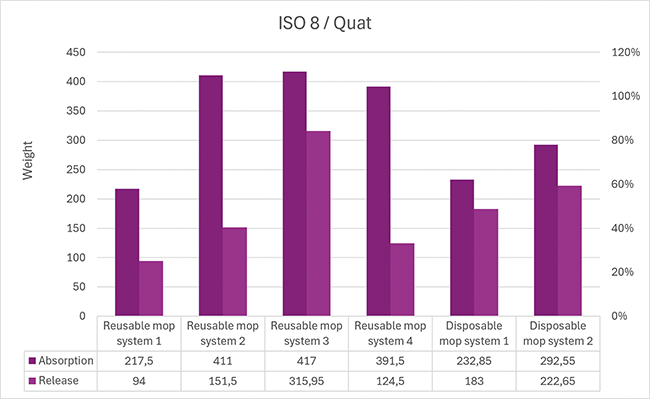
This study presents a comparative evaluation of reusable and disposable cleanroom mop systems under controlled ISO class 8 cleanroom conditions (according to ISO 14644-1). Key performance parameters included absorption capacity, liquid release, surface coverage, and wet contact time using a quaternary ammonium compound at different saturation levels. The results demonstrate that increased liquid loading improves both surface coverage and contact time across all systems. Reusable mop systems generally exhibited higher absorption capacity and more consistent liquid distribution, enabling extended coverage and longer wet contact times. Disposable systems showed more limited absorption and earlier performance decline over larger surface areas. The findings underline the importance of mop design and saturation strategy in optimizing cleaning efficiency and operational effectiveness in cleanroom environments.
Correspondence:
Arthur Lettinga
Elis Cleanroom, Koopman Heeresweg 10, 8701 PR Bolsward,
The Netherlands
arthur.lettinga@elis.com
 | Arthur Lettinga has been part of the Elis Cleanroom group for over 10 years. As Product Manager, he is responsible for driving innovation in process and product development, ensuring that cleanroom textiles meet the evolving demands of customers. A key aspect of his role involves providing regular training and education, not only on products but also on general cleanroom knowledge. |
Abstract
This study presents a comparative evaluation of reusable and disposable cleanroom mop systems under controlled ISO
Schließen Sie hier ein Abonnement ab und profitieren Sie von den vielseitigen Nutzungsmöglichkeiten.