



Material airlocks
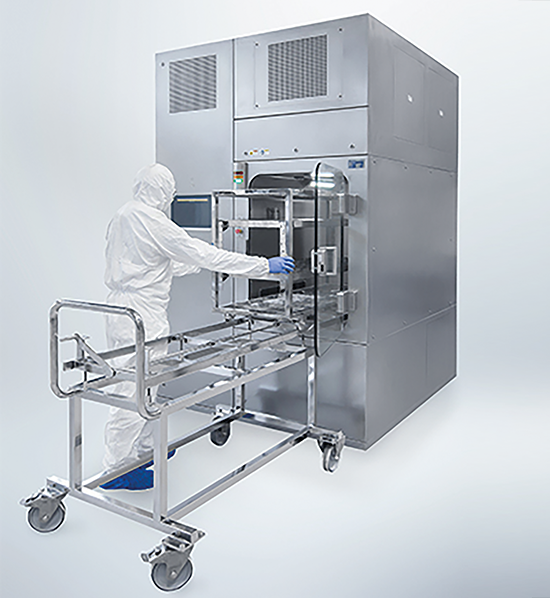
Safe and controlled room-to-room transfers
Technik

Abstract
Aseptic filling lines are always operated in a controlled environment, specifically either in an EU Good Manufacturing Practice (GMP) Class D or in EU GMP Class C classification. That also requires that all supporting equipment, maintenance tools, and consumables need to be transferred under controlled conditions into the filling line environment.
A solution for the controlled room-to-room transfer are material airlocks connecting rooms with different environments. Today these material airlocks provide freedom and flexibility in design, size, loading type, and in simple installation that the material airlock will fit exactly in existing buildings without the need of changing or adapting building and room layouts. This flexibility is even given at large volume airlocks.
These new material airlocks neither require separate piping nor integration in an existing ventilation. The transfer process is fully automated and therefore facilitates the required validation steps.
Correspondence:
Harald Kiesel
Skan AG, Kreuzstr. 5, 4123 Allschwil
harald.kiesel@skan.ch
 | Harald Kiesel is a strategic product manager at Skan AG responsible for sterile test isolators and material transfer isolators. He holds a degree in chemical engineering and a MBA in business management from the Universities of Augsburg and Pittsburgh. He gained experience in various roles in marketing and product management in both the chemical and pharmaceutical industries. |
Abstract
Aseptic filling lines are always operated in a controlled environment, specifically either in an EU Good Manufacturing Practice (GMP) Class D or in EU GMP Class C
Schließen Sie hier ein Abonnement ab und profitieren Sie von den vielseitigen Nutzungsmöglichkeiten.